Thursday, July 30, 2015


Jinn

Jinn Pyramids
From Jinn Group Yahoo
This is from Edward W. Lane’s notes on the Jinn from his translation of the Thousand and One Nights:
It is said that God created the Jánn [or Jinn] two thousand years before Adam [or, according to some writers, much earlier]; and that there are believers and infidels and every sect among them, as among men.
Some say that a prophet, named Yoosuf, was sent to the Jinn: others, that they had only preachers, or admonishers: others, again, that seventy apostles were sent, before Mohammed, to Jinn and men conjointly. It is commonly believed that preadamite Jinn were governed by forty (or, according to some, seventy-two) kings, to each of which the Arab writers give the name of Suleymán (or Solomon); and that they derive their appellation from the last of these, who was called Jánn Ibn-Jánn, and who, some say, built the pyramids of Egypt.
The following account of the preadamite Jinn is given by El-Kazweenee.
– “It is related in histories, that a race of Jinn, in ancient times, before the creation of Adam, inhabited the earth and covered it, the land and the sea, and the plains and the mountains; and the favours of God were multiplied upon them, and they had government, and prophecy, and religion, and law; but they transgressed and offended, and opposed their prophets, and made wickedness to abound in the earth; whereupon, God, whose name be exalted, sent against them an army of Angels, who took possession of the earth, and drove away the Jinn to the regions of the islands, and made many of them prisoners; and of those who were made prisoners was ’Azázeel [afterwards called Iblees, from his despair]; and a slaughter was made among them.
At that time, ’Azázeel was young: he grew up among the Angels [and probably for that reason was called one of them], and became learned in their knowledge, and assumed the government of them; and his days were prolonged until he became their chief; and thus it continued for a long time, until the affair between him and Adam happened, as God, whose name be exalted, hath said, ‘When we said unto the Angels, Worship ye Adam, and [all] worshipped except Iblees, [who] was [one] of the Jinn.’”
“Iblees,” we are told by another authority, “was sent as a governor upon the earth, and judged among the Jinn a thousand years, after which he ascended into heaven, and remained employed in worship until the creation of Adam.” The name of Iblees was originally, according to some, ’Azázeel (as before mentioned; and according to others, El-Hárith: his patronymic is Aboo-Murrah, or Abu-l-Ghimr.
It is disputed whether he was of the Angels or of the Jinn. There are three opinions on this point.
– 1. That he was of the Angels, from a tradition from Ibn-‘Abbás.
– 2. That he was of the Sheytáns (or evil Jinn); as it is said in the Ku-rán, “except Iblees, [who] was [one] of the Jinn:” this was the opinion of El-Hasan El-Basree, and is that commonly held.
– 3. That he was neither of the Angels nor of the Jinn; but created alone, of fire.
Ibn-‘Abbás founds his opinion on the same text from which El-Hasan El-Basree derives his: “When we said unto the Angels, Worship ye Adam, and [all] worshipped except Iblees, [who] was [one] of the Jinn” (before quoted: which he explains by saying, that the most noble and honourable among the Angels are called “the Jinn,” because they are veiled from the eyes of the other Angels on account of their superiority; and that Iblees was one of these Jinn. He adds, that he had the government of the lowest heaven and of the earth, and was called the Táoos (literally, Peacock) of the Angels; and that there was not a spot in the lowest heaven but he had prostrated himself upon it: but when the Jinn rebelled upon the earth, God sent a troop of Angels who drove them to the islands and mountains; and Iblees being elated with pride, and refusing to prostrate himself before Adam, God transformed him into a Sheytán.
– But this reasoning is opposed by other verses, in which Iblees is represented as saying, “
Thou hast created me of fire, and hast created him [Adam] of earth.” It is therefore argued, “If he were created originally of fire, how was he created of light? For the Angels were [all] created of light.”
The former verse may be explained by the tradition, that Iblees, having been taken captive, was exalted among the Angels; or perhaps there is an ellipsis after the word “Angels;” for it might be inferred that the command given to the Angels was also (and à fortiori) to be obeyed by the Jinn.
According to a tradition, Iblees and all the Sheytáns are distinguished from the other Jinn by a longer existence. “The Sheytáns,” it is added, “are the children of Iblees, and die not but with him: whereas the [other] Jinn die before him;” though they may live many centuries. But this is not altogether accordant with the popular belief: Iblees and many other evil Jinn are to survive mankind; but they are to die before the general resurrection; as also even the Angels; the last of whom will be the Angel of Death, ’Azraeel: yet not all the evil Jinn are to live thus long: many of them are killed by shooting stars, hurled at them from heaven; wherefore, the Arabs, when they see a shooting star (shiháb), often exclaim, “May God transfix the enemy of the faith!” Many also are killed by other Jinn; and some, even by men.
The fire of which the Jinnee is created circulates in his veins, in place of blood: therefore, when he receives a mortal wound, this fire, issuing from his veins, generally consumes him to ashes. The Jinn, it has been already shown, are peccable. They also eat and drink, and propagate their species, sometimes in conjunction with human beings; in which latter case, the offspring partakes of the nature of both parents. In all these respects they differ from the Angels.
Among the evil Jinn are distinguished the five sons of their chief, Iblees:
– Teer [Tir], who brings about calamities, losses, and injuries;
– El-Aawar [Al A’awar], who encourages debauchery;
– Sót, who suggests lies;
– Dásim, who causes hatred between man and wife; and
– Zelemboor [Zalambur], who presides over places of traffic. [He also presides over dishonest and fraudulent business transactions.]

Famous Jinn
Here are a few famous jinn, according to al-Damiri (14th cent.):
IBLIS — It is said that he laid 30 eggs: 10 in the west, 10 in the east and 10 in the middle of the earth. From every egg emerged a race of devils, like ghilan [ghouls], ‘aqarib [scorpions], qatarib [night
birds], jann [snakes], and those with various other names. Each of them is an enemy to mankind.
He is sometimes known as Abu Mirrah [Father of Bile]. Scholars disagree whether he is of the angels, and, regarding his name, whether it is foreign or Arabic. The Qur’an says “he was of the jinn” [Qur’an 18:50] but some scholars claim this means a band of angels called the jinn.
DASIM — When a man enters his house and does not offer greetings of peace or mention the name of God, Dasim enters with him and whispers to him and casts evil between the man and his family. If the man eats and does not mention the name of God, Dasim will eat with him.
MATUS — The master of gossip — news which has neither basis nor truth — which he brings and casts into the mouths of people. Also AL-AQNAS.
TARTABAH — The mother of Matus and al-Aqnas. (Al-Naqqash asserts that she is rather their nursemaid.)

Jinn as snakes
From al-Damiri (14th century zoologist):
In the view of Ibn Sa’d, al-Tabarani and al-Hafiz Abu Musa and others, ‘Amr ibn Jabr al-Jinni (the Jinni) was among the companions [of the Prophet Muhammad], and they relate … on the authority of Safwan ibn al-Mu’attil al-Sulami that he said: “We went out as pilgrims and when we were at al-‘Arj suddenly before us was a snake writhing … which soon died. One of our men took out a rag and wrapped it in it, then dug a hole in the ground for it. We then approached Makkah and came to the Masjid al-Haram and a man stopped in front of us saying: ‘Which of you is the friend of ‘Amr ibn Jabir?’ We said, ‘We don’t know him.’ ‘Which of you is the friend of the jann? They [the jinn] say, “May God reward you with good on our behalf. Verily he was the last of the nine of the jinn who heard the Qur’an from the Prophet — blessings and peace be upon him.”‘”
….
Ibn Abi al-Dunya, on the authority of a man from among the Tabi’in [immediate descendants of the Companions of the Prophet, i.e., the second generation], mentions that a snake entered his tent lolling its tongue from thirst so he gave it a drink, then it died and he buried it. Afterward someone came at night, greeted him, thanked him and told him that the snake was a pious man from among the jinn of Nasibin whose name was Zawba’ah. He [Ibn Abi al-Dunya] said, “We have heard among the good merits of ‘Umar ibn ‘Abd al-‘Aziz, the Umayyad Commander of the Faithful … that he was walking in a waterless land and came upon a dead snake. He wrapped it in a scrap of his cloak and buried it. Then a voice said, ‘O Sariq, I testify that I heard the Messenger of God … saying to you: “You will die in a twaerless land and a pious man will shroud and bury you.”‘
“‘Who are you? May God have mercy on you,’ he [‘Umar] said. “One of the jinn who first heard the Qur’an from the Messenger of God…,’ he replied. ‘There remain of them only myself and this Sariq who has died.'”
In the book Khayr al-bishar bi-khayr al-bashar there is on the authority of ‘Ubayd al-Muktib, from Ibrahim, who said, “A party of companions of ‘Abd Allah ibn Mas’ud … went out, and I was among them, intent on the pilgrimage. When they were on a certain road they saw a white snake coiled up on the road. The scent of musk emanated from it. I said to my companions, ‘Go on, for I will not depart until I see what is going to happen to it.’ And it soon died.
“I thought good of it due to its pleasant fragrance so I shrouded it in a rag then removed it from the road and buried it. I caught up with my companions at al-Mutassah.
“We were sitting when four women approached from the west. ‘Which of you buried ‘Amr?’ one among them asked. I replied, ‘Who is ‘Amr?’ “Which of you buried the snake?’ she said. I said, ‘I.’ ‘By God, you have buried one who fasts constantly and prays diligently and who believes in what God the Almighty and Exalted had revealed,’ she said, ‘and he believed in your prophet Muhammad … and he heard his description in heaven 400 years before he was sent.'”

Al – A`war, Satan Crier
Satan has special forces commanded by his own son named Al-A`war. Mujahid ibn Jabr, the main disciple Ibn Abbas said that the devil had five children, one of whom was named Al-A`war. He has a special task called on people to commit adultery and decorate it in order to look good in the sight of man. (Talbisul devil, Ibn Al-Jauzy p. 41)
Al-A`war also recruit demons of the human race as a successful team to campaign for fornication. All means be taken, all the means and media used.
Installing Many Feed
As an angler, he must put the bait that the fish would come near the hook. So vicious baiting that the victim would come to the trap. Feedback in the form of ‘Nisa’un kaasiyat’ ariyat’, a woman who dressed naked, porn, porn action and devices.
The bait is placed in strategic places, making it possible for prey to see it. Among the strategic place is a television and print media. So we see on our television many women who dress butt naked, sing and dance erotic, vulgar moves that can be watched by everyone. It is a sign that al-A`war devil has succeeded in recruiting many people for her use as bait. Similarly, the tabloids, newspapers and magazines make pornography as their main focus.
Because there are still too many people in their right mind, they would ruin the bait. A lot of healthy-minded people would admonish, censure and be hostile. For that, he coined terms and deception as flavoring. To turn that antipathy to neutral, neutral into sympathy, sympathy into army-soldiers.
Among the terms which inspired Al-A`war to surrogates of human groups are called bare culture as a form of progress, dating as an exploratory effort and preparation, singing slovenly and erotic dance as art and porn action referred to as freedom of expression. You could say that calling indecency with terms that assume good is its own moment in the stance devil bequeathed to his generation. Like when he persuaded Adam to his words:
“Then the devil whispering evil thoughts to him, saying:” O Adam, will I show you the tree of Eternity and a kingdom that will never perish? “(Taha: 120)
He called the forbidden tree with edible fruit trees of Eternity, which if eaten caused him eternal in Jannah.
Not different from those demons today. Misleading information accompanied with a tempting image. If it comes in repeatedly, finally it will be considered as a matter of course, or a truth that deserves to be defended. As is well understood that through continuous reporting, false news is considered facts. It is said that the western media do not care if the news is right or wrong, but only show smart or stupid news. Smart news is packaged so invisible kedustaannya, while stupid news is news that seems kedustaannya.
It seems that Al-A`war businesses and armies actually reap the harvest. So many of our generation fell into his arms. They followed the Al-A`war persuasion, took the bait, then swallowed the hook. He ‘haula walaa quwwata illa billah.’
However, we should not despair, because no matter how persistent work of Satan, for those who believe and are consistent with the faith, the cunning of Satan is weak:
“Because the real cunning of Satan is weak.” (An-Nisa ‘: 76)
Steer clear of bait demons, evil intention of destroying it to appear in the presence of humans is part of the solution and the fort for us and the muslims of Al-A`war attack and his armies, Wallahul muwaffiq.

Wednesday, March 18, 2015

Hijama Holistic Health Care

by Shireen Hakim
Muslims strive to follow the Sunnah, by living and following many of the actions and examples of our beloved Prophet Muhammad’s ﷺ (Peace Be Upon Him). We get closer to God by following his actions, such as smiling and donating to charity. What about following the Prophet’s eating habits? We also strive to eat like him, such as cooking with olive oil and enjoying pomegranates from our trees. We know that if he ate something it must have been beneficial.
However, one of his dietary habits is very significant for our health, but is mostly overlooked today. According to the Hadith literature (sayings and characteristics of the Prophet Muhammad), the Prophet ﷺ ate meat very rarely, and when he did it was mostly on special occasions or as a guest. His habitual diet actually consisted of favorite foods like dates, water, vinegar, honey, yogurt, barley bread, and grapes. Meat was available only occasionally, and when it was he favored sheep’s shoulder/foreleg. The Prophet ﷺ never ate his fill of bread and meat. As a guest he was once served gourd (pumpkin) and meat stew, and picked out the gourd to eat. The Prophet ﷺ and companions looked forward to Fridays, because a local woman served them a meatless meal with a meat substitute. Early Muslims continued the Prophet Muhammad’s ﷺ habit of rarely indulging in meat.
As the second Caliph (ruler), Umar ibn al Khattaab notably stated: “beware of meat, for it is addictive like alcohol.”
He once chastised his son for giving in to his craving and buying meat. Umar is a strong example for us as well, since the Prophet ﷺ said, “If there were a prophet after me, it would be Umar.” So in fact, eating little meat is the Prophetic Sunnah and follows early Islamic tradition.
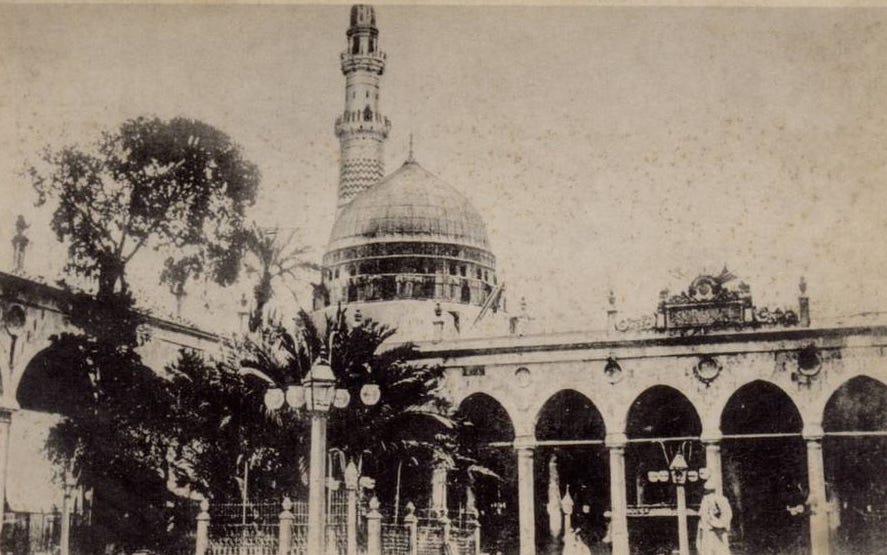
early 20th century photo of the Prophet Muhammad’s Mosque in Medina, Saudi Arabia
Nowadays, our meat eating habits severely contradict the Prophet’s ﷺ, Umar’s, and early Muslim society. There is a reason they ate meat occasionally: it is harmful when eaten regularly. Regular meat intake coincides with increased disease: heart disease, cancer, and obesity. Meat is a beneficial and permissible food, and we are blessed to have it available to us. However, we must realize that we are over consuming it, and reduce our consumption.

How did we come to think that eating meat daily is normal?

Our current meat habits mirror the Western diet, which has itself been tainted by times of war and political interests. Interestingly, early Americans also ate meat rarely. Then during World Wars I and II, meat was rationed. When peace returned meat was available again, and people mistook this luxury item for a staple. Unfortunately, as meat became part of the regular diet, heart disease and cancer rates immediately increased. Americans’ health declined so much that in the 1970’s Congress made Dietary Goals stating we should cut down on meat intake. However, meat lobbyists fought to keep meat included in US’s Dietary Guidelines. These lobbyists continue to relentlessly advertise and market meat rich ideology in our schools and nutrition programs. Therefore, we still think we need to keep eating meat every day, and that it is okay to do so. The indulgent Western diet is spreading to Asian and Latin American countries, reinforcing its façade of a normal diet.
Unfortunately, a meat rich diet is directly linked to the top causes of death in the US- heart disease, cancer, and obesity. Very high percentages of the population have these diseases: heart disease 11%, cancer 8.5%, and obesity 33%. In contrast, Americans that eat meat occasionally are significantly healthier. Flexitarians (those that eat meat a few times a week/month), have lower rates of heart disease and cancer, weigh 15% less and live about 3.6 years longer. Vegetarians do not eat meat, and weigh about 17 pounds less, live about 5 years longer, and have about 30% less cancer risk. Many people eat beef burgers, chicken wings, and meat pizza daily, suffer from a heart attack or cancer, and then strictly change their diet. Take a proactive approach and start eating healthy now, before you get sick.

So what do we eat instead of meat?

There are many delicious meatless proteins, and easy steps to take to introduce them in the diet. These proteins are: nuts and nut butters, beans and lentils, fish, tofu, eggs, milk cheese and yogurt, kale, brown rice, and quinoa. Each day, eat 5–7 ounces, or 4–6 servings of these proteins. Serving examples include: 1 cup of organic milk (8 grams of protein), 1 cup Greek yogurt (11 grams), 1 cup black beans (16 grams), 1 tablespoon natural almond butter (4 grams), 1 ounce wild salmon (5 grams), ½ cup non-GMO tofu (20 grams), 1 cup brown rice (5 grams), 1 cup quinoa (8 grams), 1 cup kale (3 grams), and 1 cup broccoli (4 grams).
These proteins are more beneficial and nutrient- rich than meat: in addition to protein, iron, and vitamin B12, they also contain monounsaturated fats, omega- 3 fatty acids, and fiber. Studies show meatless proteins improve strength in soldiers, and are easier to digest. These foods lower disease and mortality risks. They also boost metabolism, aiding in weight loss. It’s recommended to eat meatless proteins most days of the week, and meat (chicken or lamb) on one or two days. Follow these steps to incorporate a mainly meatless diet:
  1. Join the popular Meatless Monday movement: go meatless on Mondays. (If you are fasting on Monday, have a meatless suhoor and iftar.)
  2. Incorporate favorite meatless dishes in your meals, and start eating them more often (like vegetable pizza, peanut butter sandwich, and bean and rice burrito.)
  3. Make one meal a day meatless, then increase the number. Keep going until a whole day is meatless.
  4. Stock your pantry and fridge with the proteins listed above so you always have options.
  5. Go to restaurants that serve meatless meals like Chipotle, CPK, and sushi and Mediterranean restaurants.
Eating meatless proteins also saves time, energy, and stress. Meatless proteins are readily available at more locations and are always halal, therefore there is a wider selection of restaurants and grocery stores to choose from. Meatless meals improve our health and adherence to the Sunnah. It does not make one a vegetarian, and you can still enjoy eating meat.
Shireen Hakim is the Author of Amazon.com Best- Seller ‘Meatless Protein Cookbook’. Shireen studied Nutrition at UCLA, Columbia, and Loma Linda University. Shireen’s cookbooks can be found on her author page at amazon.com/author/shireenhakim

Tuesday, March 17, 2015

The Power of Istighfar – Astaghfirullah (I seek forgiveness of Allah)

Print This Post Print This Post
People often forget the importance of the simple yet powerful dua (supplication) – Istighfar i.e., saying “Astaghfirullah” (I seek forgiveness of Allah). Prophet Muhammad (peace be upon him) recited this at least 100 times a day. Let us see the benefits and virtues of reciting this simple beautiful supplication insha Allah.
  • Istighfar (Astaghfirullah) is the gateway of relief and happiness. Whenever you are in distress start reciting it and Insha Allah it will take you out of your anxiety and will put you in a peaceful situation and will give you happiness.
  • Istighfar removes anxiety and duas are answered.
  • Istighfar opens the door of sustenance.
  • Istighfar opens the door of mercy.
  • Istighfar opens the door of knowledge.
  • Istighfar is also gateway of productivity.
  • Istighfar relieves you. When you feel that sadness within you, when you are disturbed and frustrated, when anxiety surrounds you, say “Astaghfirullah” “Astaghfirullah”…
  • Reciting Astaghfiruallah is an effective method of calming our self and wipes away the variety of worldly worries from our mind and body. It may also help us, if we are suffering from depression, it calm us and lessen our depression.
  • Astaghfirullah also helps us to refrain from all forms of sins. Regularly saying this reminds us that Allah is everywhere and in this way there is very small chances of doing wrongful actions.
  • Ibn Abbas (May Allah be pleased with them) said: The Messenger of Allah (peace be upon him) said,
    “If anyone constantly seeks pardon (from Allah), Allah will appoint for him a way out of every distress and a relief from every anxiety, and will provide sustenance for him from where he expects not.” [Abu Dawud].
  • In another hadith, Abdullah bin Abbas (May Allah be pleased with them) narrates that Rasulullah (Sallallahu Alayhi Wasallam) said:
    “The one who (regularly) says Istighfaar, that is, frequently repent to Allah Ta’aala for sins committed, Allah Azza Wa-Jal will open a path from poverty and difficulties. All sorrow and hardship will be removed, and in its place prosperity and contentment granted. One will receive sustenance from unimagined and unexpected sources.”
  • Rasulullah (Sallallahu Alayhi Wasallam) has said in another Hadith:
    “The one who seeks forgiveness for Muslim males and females from Allah Ta’aala twenty six or twenty five times every day, Allah Ta’ala will count that person among those whose Du’a is accepted, and through the barakah of whom those on earth gain Rizq (sustenance).”
  • Do Tasbih of Astaghfaar at least 100 times daily as it is the Sunnah of Prophet Muhammad (peace be upon him).
  • In one minute, you can say “Astaghfiru Allaah” more than 100 times! The virtue of seeking forgiveness is well-known, it is a reason of obtaining forgiveness, entering Paradise, having good provisions, increasing one’s strength, repelling harm, having affairs facilitated, the descent of rain, and increasing in wealth and children.
  • The doors of repentance are always open therefore don’t delay your repentance in a hope of tomorrow, as tomorrow is uncertain , Repent now and make it a habit to ask Allah’s forgiveness by reciting “Astaghfirullah”.
  • Say I believe in Allah’s mercy, I have sinned, I have gone astray, I have been negligent, but still I believe in Allah’s soothing mercy and forgiveness, I’ll not despair!

IMPORTANCE OF ISTIGHFAR FROM THE QURAN:

One of the 99 Names of Allah is Al-Ghaffaar (الْغَفَّارُ) – The Great Forgiver The Forgiver, the One who forgives the sins of His slaves time and time again. There are numerous verses in the Quran about the importance of asking for forgiveness of Allah SWT. Here are few of them:
And (commanding you): “Seek the forgiveness of your Lord, and turn to Him in repentance, that He may grant you good enjoyment, for a term appointed, and bestow His abounding Grace to every owner of grace (i.e. the one who helps and serves needy and deserving, physically and with his wealth, and even with good words). But if you turn away, then I fear for you the torment of a Great Day (i.e. the Day of Resurrection). [Hud 11:3]
Declare (O Muhammad SAW) unto My slaves, that truly, I am the Oft-Forgiving, the Most-Merciful. [Al-Hijr 15:49]
Then, verily! Your Lord for those who do evil (commit sins and are disobedient to Allâh) in ignorance and afterward repent and do righteous deeds, verily, your Lord thereafter, (to such) is Oft-Forgiving, Most Merciful. [An-Nahl 16:119]
Your Lord knows best what is in your inner-selves. If you are righteous, then, verily, He is Ever Most Forgiving to those who turn unto Him again and again in obedience, and in repentance. [Al-Isra 17:25]
And verily, I am indeed Forgiving to him who repents, believes (in My Oneness, and associates none in worship with Me) and does righteous good deeds, and then remains constant in doing them, (till his death). [Ta-Ha 20:82]
And say (O Muhammad SAW): “My Lord! Forgive and have mercy, for You are the Best of those who show mercy!” [Al-Mumenoon 23:118]
Need more verses? Read the Quran! There are plenty of verses about the importance of seeking forgiveness. Some verses are addressing the previous Prophets and their people. But these are again addressing us since Allah SWT wants us to learn from the story of previous people – His acceptance of forgiveness from them and His severe punishments for the ignorant groups. So did you say “Astagfirullah” (I seek forgiveness of Allah) 100 times today? :)

Friday, February 27, 2015

Monday, July 7, 2014

This is a pic of grandfather and four grandsons from west Africa


So, the 4 Khulufa ar-Rashidin have all been historically described as BLACK MEN...but y'all still believing the lies! Wake up!
1.] Abu Bakr was the first of the Rashidun and Rightly Guided Khalifs to succeed the Prophet Muhammad. He was a pure Arab from the Taym clan of the Quraysh tribe, the Prophet Muhammad's tribe. What did he look like?
Al-Masudi reports in his Tanbih wa al-ashraf:
وكان طوالاً آدم
"He (Abu Bakr) was tall and black-skinned"
وفدت إلى أبي بكر مع أبي فدخلنا عليه في مرضه الذي مات فيه فرأيته رجلا أسمر خفيف اللحم
"I and my father came in a group to Abu Bakr and we entered in upon him in his sickness, that which he died in and I saw him as a black skinned man who was of a thin frame."
2.] Umar ibn al-Khattab was the second Rashidun Khalif, an Arab from the Banu Adi. What did he look like?
Yusef b. Al-Zaki said in his Tahdhib al-Kamal:
كان عمر طوالاً، أصلع، أقبل، شديد الأدمة
“Umar was tall, bald…very black”
3.] Uthman ibn Affan was the third of the Rashidun Khalifs. He was from the Banu Umayya of the Quraysh tribe. What did he look like?
عثمان بن عفان رضي الله عنه : كان رجلا ليس بالطويل ولا بالقصير، حسن الوجه، رقيق البشرة، بوجهه أثر جدري، كبير اللحية، عظيمها، أسمر اللون،
“Uthman ibn Affan was not tall or short, handsome face, soft skin, with prostration mark on the forehead, big beard, dark brown (asmar) colored.”
4.] Ali ibn Abi Talib was the fourth of the Rashidun Khalifs, the first cousin of the Prophet from the Banu Hashim of the Quraysh tribe. What did he look like?
Al-Suyouti says in his Tarikh Al-Khulafa:
و كان علي شيخا سمينا أصلع كثير الشعر ربعة إلى القصر عظيم البطن عظيم اللحية جدا قد ملأت ما بين منكبيه بيضاء كأنها قطن آدم شديد الأدمة
"Ali was a heavyset, bald, hairy man of average height which leaned toward shortness. He had a large stomach and a large beard which filled all that was between his shoulders. His beard was white as if it was cotton and he was a very black-skinned man (adam, shadid al-udma)."

Tuesday, April 22, 2014


TIME TO DEFEAT IGNORANCE WITH KNOWLEDGE

Educated people, like myself, are TIRED of hearing 2 arguments to JUSTIFY the Transatlantic Slave Trade

MYTH#1: Blacks sold other blacks into slavery WILLINGLY
MYTH#2: African and American/Western slavery were the SAME

SLAVERY IN AMERICA

Chattel Slavery:

Slaves in America were CHATTEL SLAVES, which mean they were considered/treated like “private property”—slaves could be purchased, traded, sold at auctions, or used as collateral. For example, it was VERY COMMON for slave masters to use their slaves as a DOWNPAYMENT or even a REPLACEMENT for their debt at Banks such as Bank of America and Wells Fargo. Since slaves were considered “private property” slave masters could get insurance on them. In fact, the health insurance company, Aetna, invested in the transatlantic slave trade and this company insured the slaves. For example, if a slave died and had insurance on them, the slave would be compensated for their “loss of property”

Perpetual Slaves:

Slaves in America were also lifetime slaves. African children inherited the status of their mother. So, if their mother was a slave, then that child would also be a slave. This is one of the reasons the “one drop rule” was created. The “one drop rule” is the idea if you have ANY AMOUNT of african ancestry, you were legally and socially classified as BLACK. Obviously the “one drop rule” created an abundance of mulattoes, and since they were considered black, they too were slaves if their mothers were. MOST mulattoes were products of a black mother and white father because it was NOT uncommon for masters to rape and have sex with their slaves. Slaves were LEGALLY considered 3/5 of a human being or subhuman

Condition:

When slaves arrived to America, they were FORCED to abandon their culture, language, belief systems, and traditional African ways of life. Slaves who attempted to preserve their identities, were savagely beaten and terrorized, as we seen in the movie, ROOTS. Africans had to adopt new identities in order to survive in the New World. The men, women, and children were RAPED repeatedly BY THEIR MASTERS. Slaves were TREATED LIKE ANIMALS and force to BREED with each other, to produce a LARGE POPULATION OF SLAVES

Slaves also experienced HORRIBLE TREATMENT. A slave master named William Byrd ll kept a diary about his slaves. Byrd explained how he FORCED one of his slaves, Eugene, to drink a pint of his own urine to punish Eugene for being a chronic bedwetter. This type of DEHUMANIZING was not uncommon for American slaves. They experienced this type of treated EVERY DAY FOR CENTURIES. Witnessing this type of violence broke slaves down mentally and discouraged them from rebelling against their masters because slave masters feared retaliation.Brutalizing and terrorizing slaves was a way slave masters kept their slaves submissive, terrified and under their control.

SLAVERY IN AFRICA

Condition:

Slavery in Africa was NOT the same kind of slavery in AMERICA. AFRICA DID NOT HAVE CHATTEL SLAVERY! Slaves were NOT treated like subhumans; they were NOT stripped of their identities, language, traditions, etc; They were NOT raped, beaten, and tortured. They were NOT forced to have sex with other slaves; They were NOT perpetual slaves; meaning they DID NOT PASS DOWN THEIR SLAVE STATUS TO THEIR CHILDREN. In fact, these African slaves ONLY WORKED FOR A SHORT PERIOD OF TIME (7 years or less). African slaves were MORE LIKE SERVANTS—they would cook, clean, serve the kings/queens, worked in the diamond, gold, and mineral mines, etc. Also, slaves ONLY became slaves AFTER they committed a crime—this was their punishment

Lastly, Africans DID NOT SELL THEIR PEOPLE WILLINGLY! They ONLY began selling each other AFTER EUROPEANS TRAPPED THEM. Remember, Europeans DID NOT simply come over to Africa and kidnapped Africans. BEFORE the transatlantic slave trade, Europeans STUDIED AFRICAN PEOPLE (language, culture, tribes, etc.) Once whites MASTERED this, they CREATED DIVISION AMONG TRIBAL GROUPS. For instance, whites would GIVE tribe A guns and tribe B no guns, and having them fighting each other. Africans DID NOT ALWAYS see each other as the SAME. White people are the ones started calling us ALL BLACK. So, because whites had ADVANCED WEAPONS, it made it easier to take over. So Africans would ONLY CAPTURE & SELL AFRICANS WHO WERE NOT FROM THEIR TRIBES. Africans, ultimately were back in a corner: either they were going to be killed by whites, taken as slaves OR capture Africans from OTHER TRIBES and have THEM SERVE AS SLAVES.

YOU CAN RESEARCH ALL THIS YOURSELVES. There are PLENTY of books, scholarly articles, and films that CONFIRM EVERYTHING I SAID. NONE OF THIS IS OPINION; IT IS FACTS!

FOR STARTERS, HERE ARE A FEW LINKS:

This movie, GOODBYE UNCLE TOMS, shows EVERYTHING that I said. (Please watch)
https://www.youtube.com/watch?v=VCtCEKzmMsQ#aid=P-TQMQozE_Q

http://www.pbs.org/wgbh/aia/part1/1h283t.html
 

Jordan, Winthrop D.. The white man's burden: historical origins of racism in the United States. New York: Oxford University Press, 1974. Print.

Stampp, Kenneth M.. The peculiar institution: slavery in the ante-bellum South. Vintage Booked. New York: Vintage Books, 19961989. Print.

Sweet, John Wood. Bodies politic: negotiating race in the American North, 1730-1830. Philadelphia: University of Pennsylvania Press, 2006. Print.

Ted Smith Son Goku Maurice Chandler Kemetic Queen

Monday, March 31, 2014

DAJJAL


"The Holy Prophet Mohammed (PBUH) said:
There is no trial or tribulation greater than that of Dajjal since the creation of man up to coming of the Day of Resurrection..."

"The last to follow him will be the women and illegitimate children..."
"When Dajjal appears, the women will assume the appearance of men, and the men will assume the appearance of women. When Dajjal appears, there will be no part of the world left which he will not dominate, except the cities of Mecca and Medina."

"Whoever hears about Dajjal should keep way from him. By Allah! One will come to come to him and will think that he is a believer, but he will follow him on account of the doubts that he will raise in his mind."
"There will be some people accompanying Dajjal, who will say: We keep him company. Although we know that he is an unbeliever, we still keep his company so that we may eat his food."

"His voice will be so loud that the whole world will hear him when he speaks."

"Dajjal will travel the entire world and request the Earth to surrender its treasures, which it will willingly do."

"He will claim himself to be Allah, and whoever has a weak faith and accepts him, Dajjal will put him into his heaven; but whoever has a strong faith in Allah and rejects Dajjal will be put into his hell fire. However, those who go into his heaven will find that Allah has turned it into hell, and those who go into his hell will find that Allah has turned it into heaven."

"All these things Dajjal will do and dominate the entire world in 40 days, from the largest country to the smallest island; and his first day will be the length of one year, but the days will gradually decline into a normal day."

Wednesday, March 5, 2014

▶ African Queens

▶ African Queens - YouTube


GREAT AFRICAN QUEENS


AMINA QUEEN Of ZARIA (1588-1589)

This queen of Zazzua, a province of Nigeria now known as Zaria, was born around 1533 during the reign of Sarkin (king) Zazzau Nohir. She was probably his granddaughter. Zazzua was one of a number of Hausa city-states which dominated the trans-Saharan trade after the collapse of the Songhai empire to the west. Its wealth was due to trade of mainly leather goods, cloth, kola, salt, horses and imported metals. At the age of sixteen, Amina became the heir apparent (Magajiya) to her mother, Bakwa of Turunku, the ruling queen of Zazzua. With the title came the responsibility for a ward in the city and daily councils with other officials. Although her mother's reign was known for peace and prosperity, Amina also chose to learn military skills from the warriors.


Queen Bakwa died around 1566 and the reign of Zazzua passed to her younger brother Karama. At this time Amina emerged as the leading warrior of Zazzua cavalry. Her military achievements brought her great wealth and power. When Karama died after a ten-year rule, Amina became queen of Zazzua. She set off on her first military expedition three months after coming to power and continued fighting until her death. In her thirty-four year reign, she expanded the domain of Zazzua to its largest size ever. Her main focus, however, was not on annexation of neighboring lands, but on forcing local rulers to accept vassal status and permit Hausa traders safe passage.


She is credited with popularizing the earthen city wall fortifications, which became characteristic of Hausa city-states since then. She ordered building of a defensive wall around each military camp that she established. Later, towns grew within these protective walls, many of which are still in existence. They're known as "ganuwar Amina", or Amina's walls. She is mostly remembered as "Amina, Yar Bakwa ta san rana," meaning "Amina, daughter of Nikatau, a woman as capable as a man.

Contributed by Danuta Bois


CANDACE

EMPRESS OF ETHIOPIA (332 B.C.)

Alexander reached Kemet (Ancient Egypt) in 332 B.C., on his world conquering rampage. But one of the greatest generals of the ancient world was also the Empress of Ethiopia. This formidable black Queen Candace, was world famous as a military tactician and field commander. Legend has it that Alexander could not entertain even the possibilty of having his world fame and unbroken chain of victories marred by risking a defeat, at last, by a woman. He halted his armies at the borders of Ethiopia and did not invade to meet the waiting black armies with their Queen in personal command.


CLEOPATRA VII

QUEEN OF KEMET (Ancient Egypt the land of the blacks) (69-30 B.C)

Although known to be of African descent she is still deliberately portrayed as being white. She came to power at the tender age of seventeen and the most popular of seven queens to have had this name. She was also known to be a great linguist and was instumental in making Kemet(Egypt) into the world number one super power at that time.


DAHIA-AL KAHINA

QUEEN KAHINA

She fought against the Arab incursion in North Africa where under her leadership Africans fought back fiercely and drove the Arab army northward into Tripolitania. Queen Kahina was of the Hebrew faith and she never abandoned her religion. Her opposition to the Arab incursion was purely nationalistic, since she favored neither Christians nor Moslems.


Her death in 705 A.D by Hassen-ben-Numam ended one of the most violet attempts to save Africa for the Africans. She prevented Islam's southward spread into the Western Sudan. After her death the Arabs began to change their strategy in advancing their faith and their power in Africa. The resistance to the southward spread of Islam was so great in some areas that some of the wives of African kings committed suicide to avoid falling into the hands of the Berbers and Arabs who showed no mercy to the people who would not be converted to Islam


HATSHEPSUT

QUEEN OF KEMET (Ancient Egypt the land of the blacks) (1503-1482 B.C.)

One of the greatest queens of ancient Kemet was Queen Hatshepsut. While she was known as a "warrior" queen, her battles were engaged with her own rivals for the position of power in Kemetic hierarchy. A born dynast in her own right, Hatshepsut proved to be an aggressive and overpowering force. However, it was not in war, but in her aspiration to ascend to the "Heru (Horus) consciousness," she displayed the strength that has given her a place in history.


She adopted the Truth of Maat and became involved in the elimination of undesirable people and elements from Kemet. Determined to be revered in times yet to come, Hatshepsut depicted herself in as many masculine attributes as possible, i.e. male attire, king’s beard, etc. Although she ascended to the throne upon the death of her king-brother Thutmose II, she exerted her rightful claim to the throne. In exercising her power, she involved herself in foreign campaigns, a concentration on domestic affairs, extensive building and commercial ventures.


The most famous of her commercial ventures was the Punt expedition in which goods and produce were acquired from the rich market there to be brought back to Kemet. While it would appear that her opponents were not antagonistic regarding her sex, they were so regarding her non-aggressive philosophy.


Even before becoming legal ruler, Hatshepsut, was actively pushing things dearest to the hearts of all Africans leaders: the expansion of foreign trade, international diplomatic relations, perfection of national defense, vast public building programs, securing the South and the North through either peace or war and, one of her "pet projects", building a great navy for both commerce and war. Her success on most of these fronts made her one of the giants of the race.


MAKEDA

QUEEN OF SHEBA (The symbol of Beauty) (960 B.C.)

"I am black but comely, O ye daughters of Jerusalem, As the tents of Kedar, As the curtains of Solomon, Look not upon me because I am black Because the sun hath scorched me." (Song of Solomon)


Although most of Black history is suppressed, distorted or ignored by an ungrateful modern world, some African traditions are so persistent that all of the power and deception of the Western academic establishment have failed to stamp them out. One such story is that of Makeda, the Queen of Sheba, and King Solomon of Israel. Black women of antiquity were legendary for their beauty and power. Especially great were the Queens of Ethiopia. This nation was also known as Nubia, Kush, Axum and Sheba. One thousand years before Christ, Ethiopia was ruled by a line of virgin queens.


The one whose story has survived into our time was known as Makeda, "the Queen of Sheba." Her remarkable tradition was recorded in the Kebar Nagast, or the Glory of Kings, and the Bible. The Bible tells us that, during his reign, King Solomon of Israel decided to build a magnificent temple. To announce this endeavor, the king sent forth messengers to various foreign countries to invite merchants from abroad to come to Jerusalem with their caravans so that they might engage in trade there. At this time, Ethiopia was second only to Egypt in power and fame.


Hence, King Solomon was enthralled by Ethiopia's beautiful people, rich history, deep spiritual tradition and wealth. He was especially interested in engaging in commerce with one of Queen Makeda's subjects, an important merchant by the name of Tamrin.1 Solomon sent for Tamrin who "packed up stores of valuables including ebony, sapphires and red gold, which he took to Jerusalem to sell to the king."2 It turns out that Tamrin's visit was momentous. Although accustomed to the grandeur and luxury of Egypt and Ethiopia, Tamrin was still impressed by King Solomon and his young nation.


During a prolonged stay in Israel, Tamrin observed the magnificent buildings and was intrigued by the Jewish people and their culture. But above all else, he was deeply moved by Solomon's wisdom and compassion for his subjects. Upon returning to his country, Tamrin poured forth elaborate details about his trip to Queen Makeda. She was so impressed by the exciting story that the great queen decided to visit King Solomon herself.3 To understand the significance of state visits in antiquity in contrast to those of today, we must completely remove ourselves from the present place and time. In ancient times, royal visits were very significant ceremonial affairs.


The visiting regent was expected to favor the host with elaborate gifts and the state visit might well last for weeks or even months. Even by ancient standards, however, Queen Makeda's visit to King Solomon was extraordinary. In I Kings 10:1-2, the Bible tells us: "1. And when the Queen of Sheba heard of the fame of Solomon concerning the name of the Lord, she came to prove him with hard questions. "2. And she came to Jerusalem with a very great train, with camels that bear spices and very much gold, and precious stones. And when she was come to Solomon she communed with him of all that was in her heart." I Kings 10:10 adds: "She gave the king 120 talents of gold, and of spices very great store and precious stones; there came no more such abundance of spices as these which the Queen of Sheba gave to King Solomon."


We should pause to consider the staggering sight of this beautiful Black woman and her vast array of resplendent attendants travelling over the Sahara desert into Israel with more than 797 camels plus donkeys and mules too numerous to count. The value of the gold alone, which she gave to King Solomon, would be $3,690,000 today and was of much greater worth in antiquity. King Solomon, and undoubtedly the Jewish people, were flabbergasted by this great woman and her people. He took great pains to accommodate her every need.


A special apartment was built for her lodging while she remained in his country. She was also provided with the best of food and eleven changes of garments daily. As so many African leaders before her, this young maiden, though impressed with the beauty of Solomon's temple and his thriving domain, had come to Israel seeking wisdom and the truth about the God of the Jewish people. Responding to her quest for knowledge, Solomon had a throne set up for the queen beside his. "It was covered with silken carpets, adorned with fringes of gold and silver, and studded with diamonds and pearls. From this she listened while he delivered judgments."4


Queen Makeda also accompanied Solomon throughout his kingdom. She observed the wise, compassionate and spiritual ruler as he interacted with his subjects in everyday affairs. Speaking of the value of her visit with the King and her administration for him, Queen Makeda stated: "My Lord, how happy I am. Would that I could remain here always, if but as the humblest of your workers, so that I could always hear your words and obey you.


"How happy I am when I interrogate you! How happy when you answer me. My whole being is moved with pleasure; my soul is filled; my feet no longer stumble; I thrill with delight.


"Your wisdom and goodness," she continued, "are beyond all measure. They are excellence itself. Under your influence I am placing new values on life. I see light in the darkness; the firefly in the garden reveals itself in newer beauty. I discover added lustre in the pearl; a greater radiance in the morning star, and a softer harmony in the moonlight. Blessed be the God that brought me here; blessed be He who permitted your majestic mind to be revealed to me; blessed be the One who brought me into your house to hear your voice.


Solomon had a harem of over 700 wives and concubines, yet, he was enamored by the young Black virgin from Ethiopia. Although he held elaborate banquets in her honor and wined, dined and otherwise entertained her during the length of her visit, they both knew that, according to Ethiopian tradition, the Queen must remain chaste. Nevertheless, the Jewish monarch wished to plant his seed in Makeda, so that he might have a son from her regal African lineage.


To this end the shrewd king conspired to conquer the affection of this young queen with whom he had fallen in love. When, after six months in Israel, Queen Makeda announced to King Solomon that she was ready to return to Ethiopia, he invited her to a magnificent farewell dinner at his palace. The meal lasted for several hours and featured hot, spicy foods that were certain to make all who ate thirsty and sleepy (as King Solomon had planned.) Since the meal ended very late, the king invited Queen Makeda to stay overnight in the palace in his quarters.


She agreed as long as they would sleep in separate beds and the king would not seek to take advantage of her. He vowed to honor her chastity, but also requested that she not take anything in the palace. Outraged by such a suggestion, the Queen protested that she was not a thief and then promised as requested. Not long after the encounter, the Queen, dying of thirst, searched the palace for water. Once she found a large water jar and proceeded to drink, the King startled her by stating: "You have broken your oath that you would not take anything by force that is in my palace.


The Queen protested, of course, that surely the promise did not cover something so insignificant and plentiful as water, but Solomon argued that there was nothing in the world more valuable than water, for without it nothing could live. Makeda reluctantly admitted the truth of this and apologized for her mistake, begging for water for her parched throat. Solomon, now released from his promise, assuaged her thirst and his own, immediately taking the Queen as his lover."6 The following day as the Queen and her entourage prepared to leave Israel, the King placed a ring on her hand and stated, "If you have a son, give this to him and send him to me."


After returning to the land of Sheba, Queen Makeda did indeed have a son, whom she named Son-of-the-wise-man, and reared as a prince and her heir apparent to the throne. Upon reaching adulthood, the young man wished to visit his father, so the Queen prepared another entourage, this time headed by Tamrin. She sent a message to Solomon to anoint their son as king of Ethiopia and to mandate that thenceforth only the males descended from their son should rule Sheba. Solomon and the Jewish people rejoiced when his son arrived in Israel. The king anointed him as the Queen had requested and renamed him Menelik, meaning "how handsome he is." Though Solomon had many wives, only one had produced a son, Rehoboam, a boy of seven.


So the king begged Menelik to remain, but the young prince would not. Solomon therefore called his leaders and nobles and announced that, since he was sending his first born son back to Ethiopia, he wanted all of them to send their firstborn sons "to be his counselors and officers." And they agreed to do so. Menelik asked his father for a relic of the Ark of the Covenant to take back with him to the land of Sheba. It is said that while Solomon intended to provide his son with a relic, the sons of the counselors, angry at having to leave their homes and go to Sheba with Menelik, actually stole the real Ark and took it to Ethiopia. Menelik returned to Sheba and, according to tradition, ruled wisely and well. And his famous line has continued down to the 20th century when, even now, the ruler of Ethiopia is the "conquering lion of Judah" descended directly from King Solomon and the Queen of Sheba.


Written by Legrand H. Clegg II


NANDI

QUEEN OF ZULULAND (Symbol of a woman of high esteem) (1778-1826)

Mother of the great leader Shaka Zulu. Nandi is the evalasting symbol of hard work patience and determination. She withstood and overcame many obsticles to raise to a position of power in all Zululand.


NEFERTARI

QUEEN OF KEMET (the land of the blacks) (1292-1225 B.C)

Her marriage to the great Rameses II of lower Ancient Egypt is known as one of the greatest royal love affair ever. This marriage also brought an end to the hundred year war between upper and lower ancient Kemet (Egypt), which in essence unified both sections into one great Kemet which was the world leading country. Monuments of this love affair still remains today in the temples that Rameses built for his wife at Abu Simbel.


The immense structures known as the two temples of Abu Simbel are among the most magnificent monuments in the world. Built during the New Kingdom nearly 3,000 years ago, it was hewn from the mountain which contains it as an everlasting dedication to King Ramses and his wife Nefertari. Superb reliefs on the temple detail the Battle of Kadesh, and Ramses and Nefertari consorting with the deities and performing religous rituals. The rays of the sun still penetrate to the Holy of Holies in the rock of the main temple on the same two days of the year: the 20th of October and the 20th of Febuary. This timing is probably connected to the symbolic unification, via the rays of the sun, of the statue of Ra-Herakhty and the statue of Ramses II. Up to today these structures remains as the largest, most majestic structures ever built to honor a wife.


NEFERTITI

QUEEN OF KEMET (Ancient Egypt the land of the blacks)

It is believe by some historians that Nefertiti was the daughter of Aye and Tiy, while other claims her as the oldest daughter of Amenhotep III. Nefertiti was married to Akhenaten the originated of the one god concept(monotheism) as it became known today. During the early life of Nefertiti she lived in a Kemet where a new model of human nature in relation to god was emerging. This belief considered man primarily has a material entity, whose happiness was measured by his ability to acquire and maintain a material heaven(wealth and pleasure). In this material heaven women were not principals that predicted or participated in social policy, but were objects of sensuality or objects to be used by men. As weaker members of this paradise women could not be participants in its building. This belief was completely contrary to the beliefs of the ancients and the principles of Ma'at. Akhenaten developed another model. The nature of his new religion was that Aton represented by the Sun was the sole god and creator of all life.


Nefertiti could not relegate herself to the traditional role of subservient-queen. She envisioned an active role for herself in reshaping civilization. This was later manifested as she is shown participating in all the religious ceremonies with Akhenaten. It was only through the combined royal pair that the god Aton's full blessing could be bestowed. Nefertiti is displayed with a prominence that other Egyptian queens were not. Her name is enclosed in a royal cartouche, and there are in fact more statues and drawings of her than of Akhenaten. Yet the priest with their materialist model were powerful and they dominated the higher government offices. In this arena women were incapable of divinity. Akhenaten and Nefertiti countered a revolt by the priest and emerged victorious and created a new capital for Kemet called Akhetaten a city that could give birth to their scared mission, a mission in pursuit of Divine life. She insisted on being portrayed has a equal divine partner to Akhenaten and their exist many illustrations of her riding a chariot with Akhenaten during major rituals. While Akhenaten's ideas wanned without him their to defend them. The priest still considered Nefertiti's heresy a greater threat. The concept of a woman bypassing the male priest hood via a mother-goddess to worship the divine was totally unacceptable. And sadly enough continues to be unacceptable in the major religions that dominate the world today. Nefertiti though her devotion and her demand for respect proved she deserved a special place in the history of women.


NEHANDA

MBUYA(Grandmother) OF ZIMBABWE

When the English invaded Zimbabwe in 1896 and began confiscating land and cattle, Nehanda and other leaders declared war. Nehanda also displayed remarkable leadership and organizational skills at a young age. Though dead for nearly a hundred years, Nehanda remains what she was when alive, the single most important person in the modern history of Zimbabwe. She is still referred to as Mbuya (Grandmother) Nehanda by Zimbabwean patriots.


NZINGHA

AMAZON QUEEN OF MATAMBA WEST AFRICA (1582-1663)

A very good military leader who waged war against the savage slave-hunting Europeans. This war lasted for more than thirty years. Nzingha was of Angoloan descent and is known as a symbol of inspiration for people everywhere. Queen Nzingha is also known by some as Jinga by others as Ginga. She was a member of the ethnic Jagas a militant group that formed a human shield against the Portuguese slave traders. As a visionary political leader, competent, and self sacrificing she was completely devoted to the resistance movement. She formed alliances with other foreign powers pitting them against one another to free Angola of European influence. She possessed both masculine hardness and feminine charm and used them both depending on the situation. She even used religion as a political tool when it suited her. Her death on December 17, 1663 helped open the door for the massive Portuguese slave trade. Yet her struggle helped awaken others that followed her and forced them to mount offensives against the invaders. These include Madame Tinubu of Nigeria; Nandi, the mother of the great Zulu warrior Chaka; Kaipkire of the Herero people of South West Africa; and the female army that followed the Dahomian King, Behanzin Bowelle.


TIYE

THE NUBIAN QUEEN OF KEMET (Ancient Egypt) (1415-1340 B.C.)

Black, beautiful and georgous, Queen Tiye is regarded as one of the most influential Queens ever to rule Kemet. A princess of Nubian birth, she married the Kemetan King Amenhotep III who ruled during the New Kingdom Dynasties around 1391BC. Queen Tiye held the title of "Great Royal Wife" and acted upon it following the end of her husband's reign. It was Tiye who held sway over Kemet during the reign of her three sons Amenhotep IV (Akhenaton), Smenkhare, and the famous child king Tut-ankh-amen. For nearly half of a century, Tiye governed Kemet, regulated her trade, and protected her borders. During this time, she was believed to be the standard of beauty in the ancient world.


YAA ASANTEWA

Yaa Asantewa of the Ashanti Empire

Her fight against British colonialists is a story that is woven throughout the history of Ghana.


One evening the chiefs held a secret meeting at Kumasi. Yaa Asantewa, the Queen Mother of Ejisu, was at the meeting. The chiefs were discussing how they should make war on the white men and force them to bring back the Asantehene. Yaa Asantewa noticed that some of the chiefs were afraid. Some said that there should be no war. They should rather go to beg the Governor to bring back the Asantehene King Prempeh. Then suddenly Yaa Asantewa stood up and spoke. This was what she said: "Now I have seen that some of you fear to go forward to fight for our king. If it were in the brave days of, the days of Osei Tutu, Okomfo Anokye, and Opolu Ware, chiefs would not sit down to see thief king taken away without firing a shot. No white man could have dared to speak to chief of the Ashanti in the way the Governor spoke to you chiefs this morning. Is it true that the bravery of the Ashanti is no more? I cannot believe it. It cannot be! I must say this, if you the men of Ashanti will not go forward, then we will. We the women will. I shall call upon my fellow women. We will fight the white men. We will fight till the last of us falls in the battlefields." This speech stirred up the men who took an oath to fight the white men until they released the Asantehene. For months the Ashantis led by Yaa Asantewa fought very bravely and kept the white men in the fort. Yet British reinforcements totaling 1,400 soldiers arrived at Kumasi. Yaa Asantewa and other leaders were captured and sent into exile. Yaa Asantewa's war was the last of the major war in Africa led by a women.